BEng vs BSc: Which Engineering Degree Is Best for Careers (Guide)
Choosing a college major often feels like a high-stakes gamble where the rules are hidden in fine print. I have spent over 14 years as an education policy analyst, and I frequently see students paralyzed by the choice between a Bachelor of Engineering (BEng) and a Bachelor of Science (BSc). This confusion is not just about a name on a diploma; it affects your course load, your ability to get licensed, and how an engineering employer views your resume during that critical first job search. Many students, like a mentee of mine named Alex, worry that picking the “wrong” one will lead to underemployment or a mountain of debt without a clear return on investment.
Throughout my career, I have analyzed thousands of institutional programs and National Center for Education Statistics (NCES) reports. I have seen how nomenclature—the specific title of your degree—can change the trajectory of a career. In my own undergraduate journey, I realized that the “best” degree is the one that aligns with the specific professional standards of the industry you want to enter. This guide will use data from the Bureau of Labor Statistics (BLS) and the College Scorecard to help you navigate these two pathways with confidence.
Wondering What Is the Best Bachelor’s Degree for Your Career Goals?
Choosing the best bachelor’s degree for careers requires a clear understanding of how different academic paths translate into the workplace. This decision involves looking at starting salaries, the specific skills you will learn in the classroom, and how quickly you can achieve professional certification after graduation.
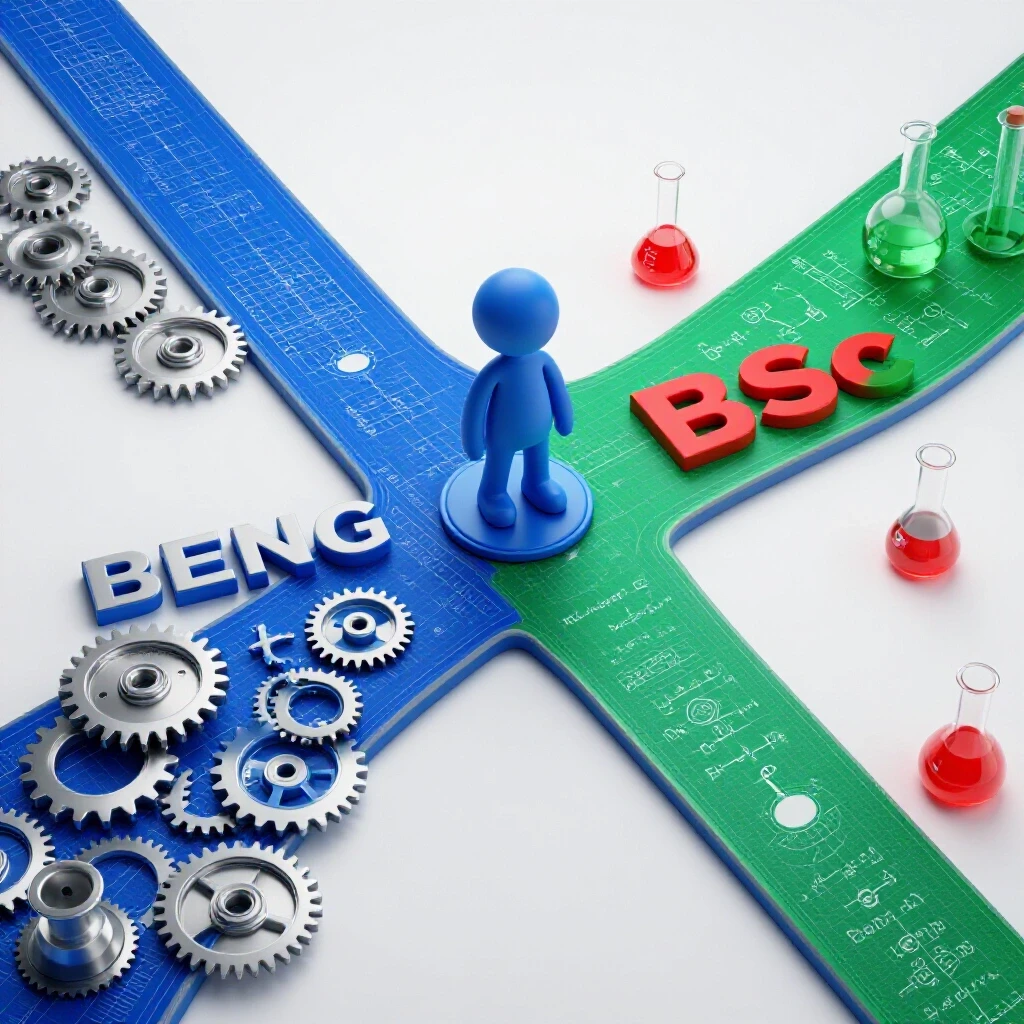
When I mentor high school seniors or college freshmen, I always start by asking about their end goal. Are you looking to design bridges, or are you interested in the physics of how materials behave at a molecular level? The BEng and the BSc represent two different philosophies of education. One is vocational and design-heavy, while the other is scientific and research-heavy. Understanding this distinction early can save you from a mid-college pivot that might add a year to your graduation timeline and thousands of dollars to your student loan balance.
What is a Bachelor of Engineering (BEng)?
A Bachelor of Engineering (BEng) is a professional degree that emphasizes the practical application of technical knowledge and design principles. It is typically structured to meet the specific academic requirements for professional licensure, focusing heavily on hands-on lab work and industry-standard engineering projects that prepare students for immediate entry into the workforce.
In a BEng program, the curriculum is often “prescribed.” This means you have fewer electives and more mandatory classes that cover the technical aspects of your chosen field, such as civil, mechanical, or electrical engineering. Employers often view BEng graduates as “plug-and-play” candidates. They expect you to have a strong grasp of CAD software, project management, and the specific codes and standards used in the industry.
What is a Bachelor of Science (BSc) in Engineering?
A Bachelor of Science (BSc) in Engineering is an academic degree that prioritizes the scientific and mathematical theories behind engineering concepts. While it covers core engineering principles, it often includes a broader scientific curriculum, allowing for more flexibility in research-oriented roles, interdisciplinary career paths, or further graduate study in science or medicine.
The BSc is often the standard in the United States, where it is frequently abbreviated as a BS in Engineering. However, in international contexts like the UK or Australia, the BSc is often seen as more theoretical. If you are a student who loves the “why” behind the “how,” a BSc might be the better fit. It provides a foundation that is excellent for those who might want to transition into data science, patent law, or advanced research later in their careers.
Choosing the Right Major: An Engineering Employer’s Perspective
When choosing the right major, it is vital to understand that employers use your degree title as a signal of your baseline competency. Hiring managers in engineering firms often look for specific accreditation markers that tell them you have been trained to handle the safety and ethical responsibilities of the profession.
I once consulted for a mid-sized civil engineering firm that was reviewing entry-level resumes. The lead engineer told me they prioritized BEng applicants for design roles because those students typically had more experience with “capstone” projects—year-long assignments where they had to build a functional prototype or design a real-world system. Conversely, for their analytical and research-and-development (R&D) roles, they often looked for BSc graduates who had a deeper background in advanced mathematics and materials science.
- Technical Readiness: BEng graduates are often viewed as having more immediate “shop floor” or “site” readiness.
- Theoretical Depth: BSc graduates are often seen as having stronger analytical tools for solving novel, non-standard problems.
- Accreditation: Employers look for ABET (Accreditation Board for Engineering and Technology) in the US or Washington Accord-aligned degrees globally.
- Onboarding: BEng hires may require less technical training during their first six months compared to BSc hires who might need more time to learn specific industry software.
College Planning Guides: Understanding Professional Accreditation
College planning guides often overlook the importance of accreditation, yet it is the single most important factor for an engineering career. Professional accreditation ensures that your degree meets the standards required to eventually become a Licensed Professional Engineer (PE) or a Chartered Engineer (CEng).
In many regions, a BEng is specifically designed to be an “integrated” route to professional status. For example, in the UK, a BEng (Hons) is the standard academic base for becoming an Incorporated Engineer (IEng). To become a Chartered Engineer (CEng), you usually need a Master of Engineering (MEng) or a BEng plus further learning. A BSc might require you to take additional “bridge” courses to prove you have the same level of design competence as a BEng graduate.
- Washington Accord: An international agreement between bodies responsible for accrediting engineering degree programs.
- ABET: The primary accreditor for engineering programs in the US, ensuring your degree is recognized by state licensing boards.
- CEng/IEng: Professional titles that signify a high level of competence and can lead to a 15-20% increase in lifetime earnings.
- Matching Sections: Additional modules a BSc student might need to take to satisfy professional body requirements.
Comparing ROI and Career Outcomes for BEng and BSc Graduates
Comparing the return on investment (ROI) for these degrees involves looking at starting salaries, debt-to-income ratios, and long-term employability. According to the Bureau of Labor Statistics (BLS), the median annual wage for engineers was approximately $96,350 as of recent reports, significantly higher than the median for all occupations.
The following table compares key metrics for BEng and BSc pathways based on NCES data and industry trends.
| Metric | Bachelor of Engineering (BEng) | Bachelor of Science (BSc) |
|---|---|---|
| Primary Focus | Practical Design & Application | Theory, Math & Science |
| Average Starting Salary | $72,000 – $78,000 | $68,000 – $75,000 |
| 4-Year Grad Rate | 45% – 55% | 50% – 60% |
| Time to Licensure | Direct Pathway | May require extra steps |
| Common Career Path | Project Engineer, Site Manager | Research Scientist, Analyst |
| Debt-to-Income Ratio | Generally favorable (1:1.2) | Favorable, but varies by field |
Interestingly, while BEng graduates often start with a slightly higher salary in traditional engineering roles, BSc graduates sometimes see higher mid-career earnings if they pivot into high-tech sectors like software engineering or quantitative finance. Data from the College Scorecard shows that engineering majors consistently have some of the lowest “underemployment” rates, regardless of whether the degree is a BEng or a BSc.
Real-World Case Studies: How Nomenclature Impacted My Mentees
To understand the real-world impact of these degrees, we can look at two of my former mentees, whom I will call Sarah and Marcus. Both were talented students from middle-class backgrounds, and both were the first in their families to pursue engineering. Their stories highlight how choosing the right major depends on your personal strengths and career vision.
Sarah chose a BEng in Mechanical Engineering at a state university. Her program was intensely focused on manufacturing and design. By her junior year, she had completed two internships where she worked directly on automotive assembly lines. When she graduated, she had three job offers before she even walked across the stage. Her employer valued her BEng because she already knew how to use the specific lifecycle management software they used in production.
Marcus, on the other hand, chose a BSc in Engineering Science. He loved physics and wasn’t sure if he wanted to be an engineer or a researcher. His degree allowed him to take advanced electives in quantum mechanics and data modeling. While it took him a few months longer to find his first job, he eventually landed a role as a systems analyst for a renewable energy startup. His BSc gave him the flexibility to work in a role that blended engineering with high-level data analysis, a path that Sarah’s more rigid BEng might not have supported as easily.
Actionable Steps for Selecting Your Engineering Pathway
If you are currently researching options, follow these steps to ensure you make a data-driven decision. This process will help you avoid the common mistake of picking a major based on a university’s brand name rather than the specific degree structure.
- Check the Accreditation: Use the ABET website or your country’s professional engineering body (like the Engineering Council in the UK) to see if the specific BEng or BSc program is accredited.
- Review the Syllabus: Look at the junior and senior year courses. If you see “Advanced Design Project,” it is likely a BEng-style practical focus. If you see “Theoretical Fluid Dynamics,” it leans toward a BSc.
- Use the College Scorecard: Search for the specific institution and look at the “Median Earnings” for engineering graduates. This gives you a realistic ROI expectation.
- Talk to Employers: Reach out to a recruiter at a company you admire on LinkedIn. Ask them, “Do you have a preference between BEng and BSc graduates for entry-level roles?”
- Evaluate Your Math Comfort: BSc programs often require more theoretical math (like Real Analysis), while BEng programs focus on applied math (like Differential Equations for Engineers).
Tools and Resources for Your Degree Search
Navigating the college landscape requires the right tools. I recommend these resources to all my students to help them gather objective data.
- College Scorecard: This U.S. Department of Education tool provides data on tuition costs, graduation rates, and post-college earnings by major.
- BLS Occupational Outlook Handbook: Use this to find growth projections for different engineering disciplines.
- O*NET OnLine: A detailed database of occupational requirements and worker characteristics.
- Common App & UCAS: These platforms often have detailed descriptions of degree requirements for different universities.
- Coursera/edX: Take a “Bridge to Engineering” course to see if you prefer the practical problem-solving of a BEng or the theoretical foundations of a BSc.
Frequently Asked Questions (FAQ)
Is a BEng harder than a BSc? Neither is inherently “harder,” but they challenge students in different ways. A BEng often has a heavier workload in terms of lab hours and design projects, requiring strong time management and teamwork. A BSc often involves more abstract, complex mathematical theories that require high levels of logical reasoning and independent study.
Can I become a Professional Engineer (PE) with a BSc? Yes, in the United States, most engineers hold a Bachelor of Science (BS) in Engineering. As long as the program is ABET-accredited, you can sit for the FE (Fundamentals of Engineering) and PE exams. In international contexts, a BSc may require additional “top-up” modules to meet the full academic requirements for chartered status.
Which degree is better for getting a job in Silicon Valley? For tech-heavy roles in Silicon Valley, such as hardware engineering or systems architecture, both degrees are respected. However, a BSc might give you a slight edge if the role involves heavy data science or algorithm development, while a BEng is highly valued for physical product design and manufacturing roles.
Does a BEng or BSc lead to higher debt? The degree title itself does not determine debt; the institution does. However, because BEng programs are sometimes more rigid, students who switch majors late may face extra semesters, increasing their total cost. Always check the four-year graduation rate for your specific major at your chosen college to minimize the risk of “fifth-year” debt.
What if my school only offers a BS in Engineering? In the US, the BS is the standard. Employers understand this and do not penalize you for not having a “BEng” title. The key is to ensure the program is accredited and offers the hands-on project experience that employers value.
Can I switch from a BSc to a BEng mid-college? Yes, but it is easier to do during your freshman or sophomore year. Since both degrees share core math and science requirements (like Calculus and Physics), many credits will transfer. However, you may need to make up specific design or lab modules that are unique to the BEng track.
Do employers really look at the degree title? They look at the title to categorize your skill set. A BEng tells them you are a “practitioner,” while a BSc tells them you are a “scientist-engineer.” The most important thing on your resume will still be your internships, your capstone project, and your ability to explain how you solve problems.
Is one degree better for going to medical or law school later? The BSc is generally considered a better “pre-professional” degree for medical or law school. Its broader scientific focus and emphasis on theoretical analysis provide a strong foundation for the MCAT or LSAT. Many BSc engineering graduates successfully transition into patent law, where they use their technical background to protect new inventions.
Choosing between a BEng and a BSc is a significant step, but it doesn’t have to be a source of anxiety. By focusing on accreditation, understanding the difference between practical and theoretical coursework, and using data-driven tools like the College Scorecard, you can choose a path that fits your strengths. Remember that your degree is a foundation, but your curiosity and willingness to learn will ultimately drive your career success.
(This article was written by one of our staff writers, Michael Harrington. Visit our Meet the Team page to learn more about the author and their expertise.)